Through their mass adoption by young learners who are developing their own method of studying through engagement, AI-powered second brain tools are changing the productivity landscape.
To keep up with the changes and stay ahead of the curve, in this article we are going to show you how new second brain tools:
If you’re interested in how you can leverage AI tools, such as Brainfo, to take your notes organization method to the next level, make sure to read ahead.
Introduction: Upgrading Your Second Brain for 2026
As an ambitious organizer, you’ve been doing the hard work. You’ve taken meticulous notes, highlighted articles, and jotted down ideas into your preferred second brain platform.
But what if your second brain could read every document or note you’ve written in your digital library and then brainstorm the outline for your new book? Here are a few questions you should ask yourself about your current system.
With the arrival of LLMs, the paradigm has shifted. A second brain is no longer about better storage of notes and resources; it’s about active intelligence. We’re moving from a passive repository to an active thinking partner.
And this isn’t just hype. In this article, we’ll show you how new second brain tools accelerate your learning and thinking, helping you connect ideas and master new skills faster than ever before.
But first, let’s diagnose the problem.
The Collector’s Fallacy: Limits of a Passive Second Brain
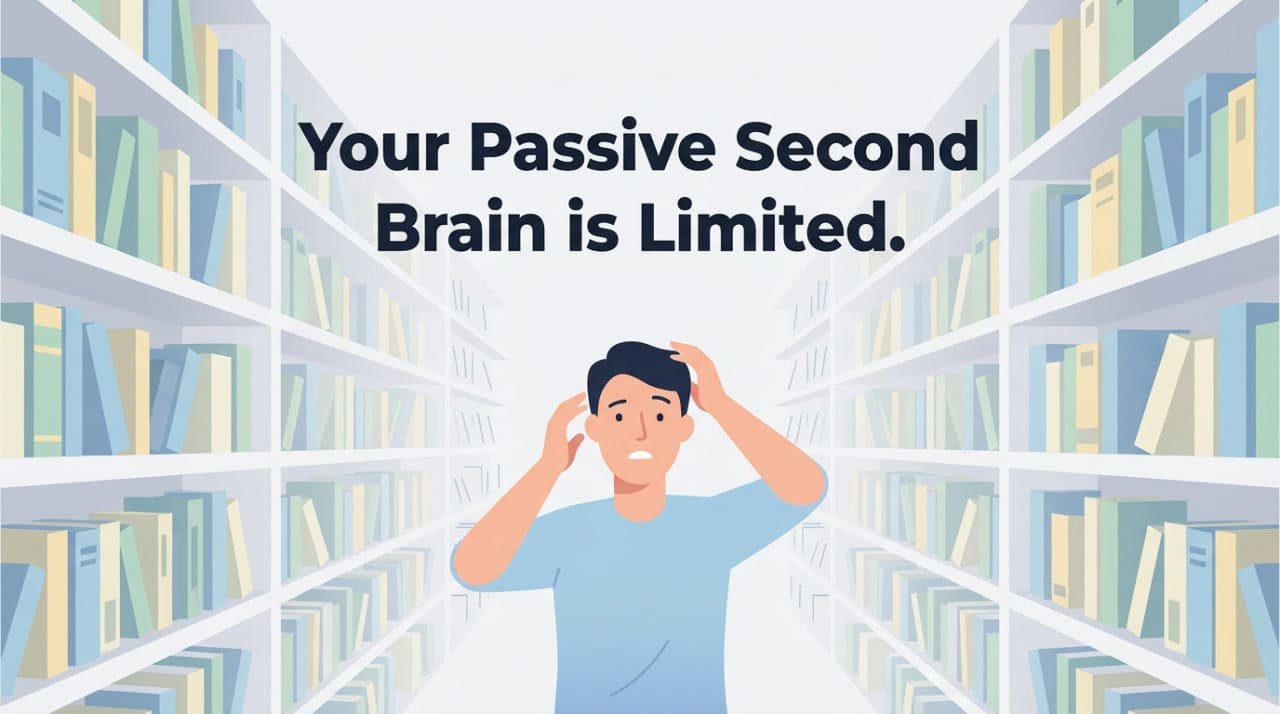
You’ve set up a system to collect notes and save important information. It’s an effective digital library. But you’ve likely noticed the bottleneck.
Over time, information piles up. After a while, it becomes a challenge to remember what you have and where it is. You may need to find a specific insight you had written while reading a book but the search function is not finding the specific point you’re looking for.
More importantly, you have a wealth of passive knowledge, but you don’t know how the pieces relate to each other or how to synthesize new ideas from them. You have the dots, but linking them together is still a manual, time-consuming chore.
This is called the Librarian’s Dilemma. A librarian knows where every book is, but they haven’t read and synthesized the knowledge between the books. That critical work is still left to you.
The Revolution is Here: AI is Changing Personal Knowledge Management
LLMs have radically changed how we approach productivity with their ability to process vast amounts of data and establish logical links between disparate ideas. Your note-taking app now has an intelligence of its own.
Intelligent note-taking doesn’t mean handing everything over to a machine and expecting it to think for you. That’s impossible.
Instead, it makes you more efficient and faster. AI can surface things you might have missed and provide a holistic view so you’re not juggling ten different ideas in your head.
This is how AI is changing personal knowledge management—not by replacing your brain, but by making information retrieval, idea connection, and synthesis dramatically easier. You still do the heavy lifting, but your AI-powered second brain is there to help you cheat the reps.
To use our library analogy again, having an AI-powered PKM [link to this blog: Forget Notes—Start Building a Personal Knowledge System]is like having a personal research assistant. The librarian can’t discuss the contents of the books with you.
But your research assistant has read everything you have and is ready to help you brainstorm.
“Your current knowledge isn’t being replaced by AI. It’s being amplified by it.”
~Tiago Forte
So, how is this new form of intelligent note-taking actually possible? This leap forward rests on a powerful technique called Retrieval-Augmented Generation (RAG).
Here’s a great video on how AI-powered Second Brain tools are helping humans do more in less time.
So, how is this new form of intelligent note-taking actually possible? This leap forward rests on a powerful technique called Retrieval-Augmented Generation (RAG). Let’s break that down in two simple steps:
The perfect analogy is a brilliant expert (the LLM) being given a specific, confidential briefing (your notes) right before answering your question.
This ensures the answers are not only smart but are also relevant, personal, and grounded in your curated knowledge, not the chaos of the open web.
The Learning Accelerator in Action: 3 Ways an AI Second Brain Puts You on the Cutting Edge
While the hype surrounding the exciting new ways we get to engage with our learning material is justified, the question remains, how does this learning acceleration work in practice?
Whether it’s learning through questions, discovering unexpected links, or transforming your notes into creative output, the future of learning through digital thinking is here. Essentially, there are three ways an AI Second Brain gives you a competitive edge.
1. Become a Faster Learner with an AI Socratic Tutor
The Socratic method stimulates critical thinking by asking questions, not just giving answers. Your AI Second Brain can now act as a tireless Socratic tutor that is an expert in one subject: your notes.
Imagine you’ve saved 10 articles on quantum computing. Instead of re-reading all of them, you can now ask your AI tutor:
It can then quiz you on key concepts, ask you to compare different theories, and instantly check your answers against the source material, dramatically improving your comprehension and retention.
2. Uncover Hidden Connections with an Idea Synthesizer
While true creativity remains uniquely human, AI is an incredible catalyst for it. It can spot patterns and connections our own brains might miss.
Imagine you have notes from a book on biology, a podcast about market trends, and a meeting about a new project.
You can ask your AI-powered second brain:
The AI can visualize these connections, helping you bridge disparate domains and spark truly innovative ideas.
3. Go from Insight to First Draft with a Creative Muse
For any creator, the heaviest lift is often the research and outlining phase. AI can supercharge this process. You can use it to rapidly browse through your saved documents and links to find relevant information.
Then, you can ask your AI muse to work with that research. For example:
This overcomes the dreaded blank page and turns your stored knowledge into active creation.
These capabilities might sound futuristic, but their foundations are being laid today.
We’re seeing powerful proofs-of-concept emerge, like Google’s NotebookLM, which is built on this very principle of grounding AI in your personal documents. It’s a fantastic showcase of what’s possible when you can ‘talk’ to your sources.
However, these early tools often exist as separate experiments, distinct from your core note-taking workflow.
They prove what is possible, but they highlight the next challenge: integrating this power seamlessly into the place you already live and think.
The true revolution won’t just come from a special-purpose tool; it will come from making this intelligence a native part of your second brain.
Grounding the Vision: You Are Still the Thinker
There’s a lot of buzz about AI replacing humans. As the linguist Noam Chomsky noted, saying machines “think” is like saying submarines “swim.”
They simulate the action, but the mechanism is fundamentally different. Read The False Promise of ChatGPT to learn more about this.
There’s a lot of buzz about AI replacing humans. As the linguist Noam Chomsky noted, saying machines “think” is like saying submarines “swim.”
They simulate the action, but the mechanism is fundamentally different. Read The False Promise of ChatGPT to learn more about this.
The same is true here. AI is an amplifier and a facilitator, not a replacement for you. The performance of your AI-powered second brain depends entirely on the quality of the knowledge you feed it. Garbage in, garbage out.
Your curation, your questions, and your critical thinking are more important than ever. AI isn’t your brain; it’s a powerful tool for your brain.
The Future is Brainfo
The capabilities we’ve discussed here are not far off. In fact, most of them are being currently implemented. But to stay on the cutting edge, you need a tool that is built from the ground-up with AI integration in mind.
Brainfo is that tool. It integrates all the top LLMs in your workspace, where you can save notes, documents, tasks, links from the web, youtube videos, and files.
Its AI copilot is context aware and can generate responses based on the information you’ve provided.
Brainfo is being designed as a true Learning Accelerator. We’re integrating the Socratic Tutor, the Idea Synthesizer, and the Creative Muse into one seamless experience. The competitive edge of tomorrow belongs to those who can learn, connect, and create the fastest.
Be one of the first to experience the future of learning and personal growth. Join the Brainfo waitlist to secure your early access.
Conclusion: Your Next-Generation Toolkit
The era of the digital filing cabinet is over. We’ve moved beyond simply collecting information and into a new frontier of active collaboration with our knowledge. Your Second Brain is no longer just a library for storage; it’s evolving into an intellectual partner for thinking.
By acting as your personal Socratic tutor, idea synthesizer, and creative muse, an AI-powered system doesn’t just help you find information—it helps you understand it, connect it, and create from it at a speed that was unimaginable before.
But remember, you are always the conductor of this orchestra. The power of this new technology is a direct reflection of your curiosity, your critical thinking, and the quality of the knowledge you cultivate. The AI is the amplifier; you are the signal.
The future of learning and personal growth belongs to those who can harness these tools to augment their own intellect. Your new partner in thinking is ready. The only question is: what will you create together?
Be one of the first to experience the future of learning and personal growth. Join the Brainfo waitlist to secure your early access.
Frequently Asked Questions
1. How do AI second brains change how we work?
A: They turn static notes into active idea networks, enabling faster retrieval and smarter decision-making.
2. How does this differ from traditional note-taking apps?
A: Traditional apps just store data; AI apps reason with it to surface connections and generate new insights.
3. How does RAG (Retrieval-Augmented Generation) aid learning?
A: It grounds AI in your private notes, allowing it to tailor explanations specifically to your existing knowledge.
4. Why is human critical thinking still required?
A: AI amplifies your input but cannot verify facts, judge truth, or understand nuance like a human.
5. How does an AI tutor help researchers?
A: It connects patterns across disciplines and turns scattered data into structured, usable insights.
6. How should I prepare my data for these tools?
A: Focus on curating high-quality notes and consistent organization to provide the AI with better context.