
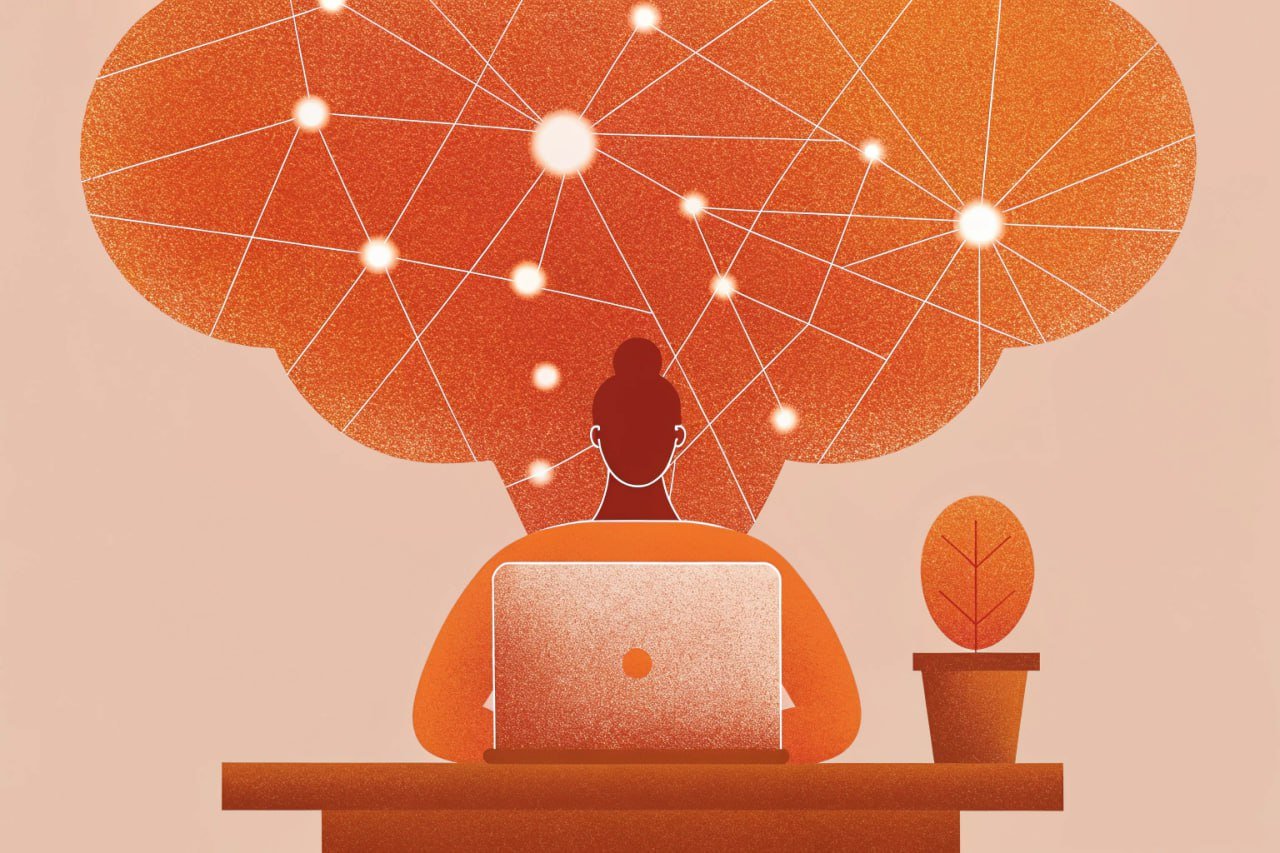
The rapid evolution of AI is fundamentally accelerating the capabilities and possibilities of second brain systems. Aside from adding features, a second brain system reshapes the very nature of how we interact with and derive value from our accumulated knowledge, marking a true evolution in knowledge management. This rise of the second brain is more than just a productivity hack; it signifies a new era of empowered thinking and intellectual leverage.
Far from science fiction, this is a practical, transformative approach to personal knowledge management (PKM) in the digital era. At its core, a second brain is an external, organized system – typically leveraging digital tools – designed to reliably capture, store, synthesize, and retrieve the valuable information and ideas we encounter.
The Second Brain is like an extension of our brain, our biological mind. It offloads the burden of remembering everything and freeing up mental bandwidth for deeper thinking, analysis, and creation.
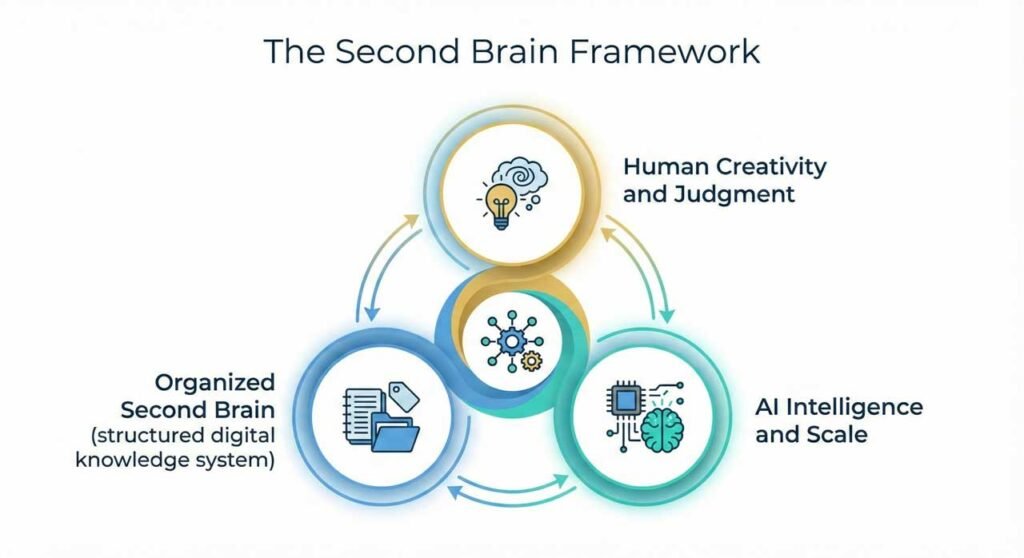
The Problem with Traditional Knowledge Management: Why Our Old Systems Are Failing Us
For years, people relied on handwritten notebooks, stacks of papers, and later, simple digital folders to manage their ideas and information.
Those systems were practically fine as our lives’ speed used to move at a slower pace. Today, data multiplies every second and you won’t be able to keep up unless you look for another way. The problem with traditional note-taking doesn’t just regard some minor inconveniences.
It’s time to look at why these systems fail—and what’s beginning to take their place.
The Hidden Cost of Fragmented Information
Important meeting notes might be sitting in an old notebook.
A brilliant quote from an article could be lost somewhere in your bookmarks.
And your best project ideas? Scattered across emails, sticky notes, and forgotten files.
When information is spread out like this, it becomes nearly impossible to see the bigger picture.
You end up with disconnected fragments instead of a cohesive body of knowledge.
Every time you need to find something, it turns into a frustrating scavenger hunt that drains your energy and focus.
Why We Forget What We Know: The Recall Paradox
“I used to waste 20 minutes hunting for a single client note. With a proper digital system, now I find it in seconds.” — Brainfo user testimonial
Traditional systems rely heavily on remembering where you put something.
As volumes grow, recall fails.
Search functions in basic apps often fall short, especially if notes lack structure or consistent tagging.
This transforms digital archives into digital graveyards—vast repositories of potentially valuable information that are effectively unusable because retrieval is so unreliable.
How often have you remembered taking notes on a topic, only to spend fruitless minutes (or hours) searching?
The Trap of Static Storage: Why Collecting Isn’t Creating
We collect information—articles saved “for later,” notes diligently taken in meetings, quotes copied into documents—but rarely do anything substantive with it.
This accumulation feels productive (“I’m saving this!”) but often leads to overwhelm and underutilization.
The result?
True knowledge creation—synthesizing information, generating original thought, building upon ideas—gets stifled by the sheer effort required to manage the hoard.
The Digital Shift: From Traditional Tools to Second Brain Systems
The limitations of old methods have sparked a digital thinking revolution.
We’re no longer passively drowning in data; we’re building systems designed to navigate it.
Modern “tools for thought” like Notion, Obsidian, Logseq, Roam Research, and purpose-built newcomers like Brainfo go far beyond digital notebooks.
They act as cognitive partners—dynamic ecosystems that enable smart, structured organization and connection of information.
The Core Principles Powering Modern PKM Tools
| Core Feature | What It Does | Why It Matters |
| Bidirectional Linking | Notes connect both ways, showing related ideas instantly. | Reveals hidden relationships and context. |
| Granular Tagging & Metadata | Information is categorized along multiple dimensions. | Avoids rigid folders and improves retrieval. |
| Intelligent, Universal Search | Finds data in text, PDFs, images, or transcripts. | Turns “I think I saw that” into “Here it is.” |
The AI Inflection Point: When Knowledge Systems Become Intelligent
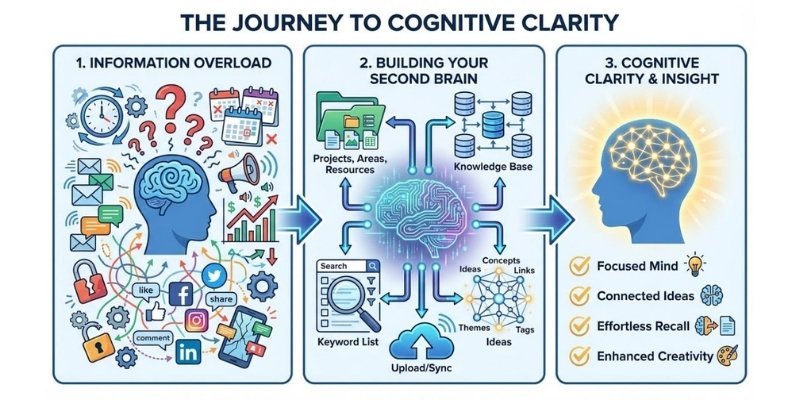
While linking and tagging were game-changers, AI integration has taken second brain systems to an entirely new level.
AI now acts as a cognitive copilot, automating tedious tasks and amplifying creative thinking.
This is how it looks like in practice:
Building an Effective Second Brain Workflow: From Chaos to Creation
Understanding the why and what of second brains is crucial, but the real magic lies in the how.
How do you transform a collection of tools and ideas into a truly effective, living system that amplifies your thinking and output?
It requires intentional design—a structured workflow.
Let’s break down actionable strategies and frameworks to build yours.
Foundational Frameworks: Choosing the Blueprint That Fits You
Several proven methodologies provide structure for your second brain. Don’t get stuck overanalyzing—experiment to find what resonates:
The PARA Framework (Projects, Areas, Resources, Archives — by Tiago Forte)
This popular method is celebrated for its simplicity and action-orientation:
Projects: Short-term, goal-driven efforts with a clear outcome you’re actively working on.
Areas: Long-term responsibilities you must maintain over time (health, finances, roles).
Resources: Topics of ongoing interest that support learning, creativity, or future projects.
Archives: Inactive items from the other categories kept for reference or future use.
| PARA Category | Description | Example |
| Projects | Active, time-bound goals with clear outcomes | “Launch Q3 Marketing Campaign,” “Write Chapter 1” |
| Areas | Ongoing responsibilities or parts of life you maintain | “Health,” “Finances,” “Team Management” |
| Resources | Topics or interests collected for future use | “AI Ethics,” “Leadership Models” |
| Archives | Completed or inactive projects | “2023 Tax Filing,” “Past Campaigns” |
How Brainfo Supercharges Your Workflow and Deep Work
Brainfo integrates AI directly into this workflow, transforming friction into flow.
Here’s how it elevates your second brain system:
- Intelligent Capture & Processing
AI summarizes clipped content, suggests tags, and extracts key entities (people, companies, concepts), drastically reducing your processing tax.
- Contextual Retrieval
Need info for a project? Brainfo’s AI understands context and surfaces the most relevant notes, tasks, and links—even those loosely related—preserving your deep work focus.
- Proactive Connection Suggestions
As you write or review, Brainfo analyzes your content and recommends connections to related or forgotten notes, strengthening your knowledge web automatically.
- Synthesis Support
Stuck starting something? Ask Brainfo to:
“Generate an outline for a blog post on X using my notes,” or “Summarize key arguments for and against Y.” It leverages your stored knowledge to fuel creation.
By combining a clear framework, disciplined workflow, and AI-powered assistance through tools like Brainfo, you build more than a second brain—you build an innovation engine.
The next section explores how this transformation expands your creative and cognitive capabilities.
Who Benefits Most from Second Brain Systems: Unlocking Potential Across Professions
The beauty of second brain systems lies in their versatility.
While anyone overwhelmed by information can gain relief, certain groups experience transformative benefits, turning chaos into clarity and competitive advantage.
Let’s see how different professionals leverage these AI-powered productivity systems.
The Agile Freelancer: Turning Client Chaos into a Reusable Asset Library
Pain Points:
Second Brain Solution:
Acts as a centralized client knowledge hub and content reuse engine.
| Freelancer Workflow | How It Works | Benefit |
| Client Portals | Dedicated sections per client storing preferences, project history, key contacts, contract terms, and meeting summaries—retrievable via AI search | Instant recall and smoother communication |
| Content Snippet Vault | Tagged repository of quotes, case studies, templates, and research snippets surfaced by Brainfo’s AI | Faster, tailored proposal and content creation |
| Project Templating | Store successful project workflows, checklists, and resources for easy reuse | Scalable, consistent client delivery |
The Strategic Student: Transforming Study Notes into Lifelong Knowledge
Pain Points:
Second Brain Solution:
Functions as a personalized learning companion and knowledge retention engine.
Core Benefit: Deeper understanding, efficient studying, and durable learning that lasts well beyond exams.
The Organized Professional: Managing Complexity and Making Better Decisions
Pain Points:
Second Brain Solution:
Becomes a decision log, strategic tracker, and institutional memory for professionals.
Core Benefit: Enhanced accountability, faster onboarding, consistent execution, and decisions backed by reliable knowledge.
Looking Ahead: The Future of Second Brain Systems and AI — Your Cognitive Copilot Is Emerging
We are standing at the threshold of a profound transformation in how humans interact with knowledge.
The rise of the second brain—now supercharged by AI—is not a passing productivity trend.
It represents a foundational shift in personal knowledge management and cognitive augmentation.
The next generation of these systems won’t just store your thoughts; they’ll think with you.
How AI Will Power Intelligent Knowledge Discovery
AI is evolving from a helpful assistant into a true partner in thinking.
Its role is expanding far beyond summarization, search, and tagging.
Here’s what’s coming next:
- Predictive Organization & Automatic Synthesis:
AI will organize information before you touch it—parsing emails, tagging documents, linking them to projects, and surfacing patterns you might miss. - Deep Contextual Understanding:
Your system will learn why information matters to you—your goals, working style, and focus areas—and provide personalized insights and warnings. - From Retrieval to Generative Partnership:
AI won’t just help you find information. It will help you think—combining your notes into new perspectives, generating arguments, or suggesting fresh creative directions.
The Convergence of Memory, Creativity, and Productivity
The boundaries between remembering, creating, and executing are dissolving.
Your future second brain will unify them all:
The result? A living cognitive ecosystem—a workspace that adapts, learns, and amplifies your mind.
Brainfo’s Vision: Building Your Dynamic Thinking Partner
At Brainfo, we’re not just building software.
We’re crafting an adaptive system that evolves with you and elevates your intellectual capacity.
Our vision focuses on four pillars:
Embrace the Cognitive Revolution — Become Future-Ready
This digital revolution isn’t about surviving information overload—it’s about gaining a cognitive advantage.
Early adopters aren’t just managing notes; they’re expanding their mental capacity to learn, create, and solve problems faster.
By adopting AI-integrated tools like Brainfo, you’re not just building a second brain—you’re crafting an intelligent partner.
A partner designed to amplify your thinking and help you shape the future of knowledge work.
The era of the overwhelmed mind is ending. The era of the augmented thinker has begun.
Start building your second brain today—and step into the next evolution of human potential.
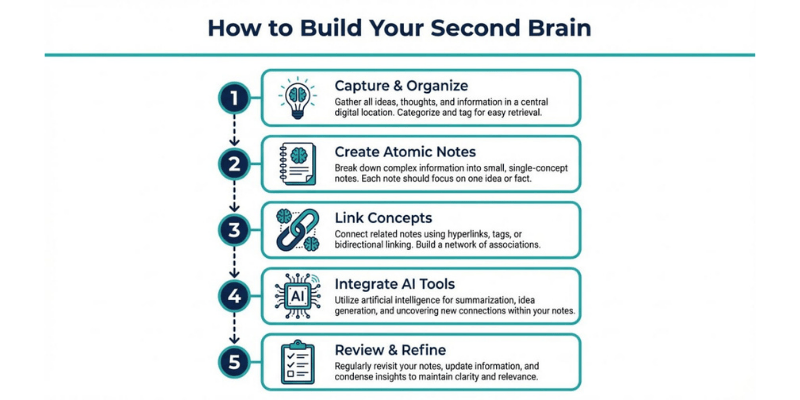
Conclusion: Embrace Your Cognitive Revolution & Build Your Second Brain Today
The relentless tide of information isn’t slowing down—it’s accelerating.
Yet as we’ve explored, the rise of the second brain marks a powerful transformation: from drowning in data to navigating it with purpose.
We’ve moved beyond scattered notes and lost insights.
Modern, AI-powered second brain systems redefine how we capture, connect, and create knowledge.
Why They Matter: They eliminate inefficiencies—siloed data, poor recall, and passive hoarding—turning overload into clarity and momentum.
How They Work: With principles like bidirectional linking, semantic AI search, and contextual intelligence, they form dynamic, connected ecosystems that support deeper thinking.
Who Benefits: Freelancers, students, executives, and creators alike gain a cognitive edge through systems that grow with their work.
The Future: AI turns your second brain into an intelligent partner that predicts, curates, and inspires.
The digital thinking revolution is already here. The advantage goes to those who build their augmented intelligence now.
Don’t just manage information—master it.
Don’t just remember—create, decide, and innovate.
If Second Brain is intriguing for you, we suggest you go over this blog for further explanations.
1. Q: How do I choose the right tool if I already use multiple apps?
A: Pick the tool that feels most intuitive and ensures daily usage. Prioritize features like easy linking and open data formats over fancy bells and whistles; consistency is key.
2. Q: Which notes should I keep versus archive?
A: Keep only what is meaningful, actionable, or connected. If a note hasn’t been useful in months, archive it to keep your system fast and focused.
3. Q: How do I integrate tasks without turning my brain into a to-do list?
A: Use your Second Brain for context, not just checklists. Link tasks to their relevant goals and reference materials so every action is grounded in understanding.
4. Q: How do I revive an abandoned or cluttered system?
A: Start small. Spend just 30 minutes decluttering, then commit to capturing and linking one new idea per day to naturally rebuild momentum.
5. Q: How do I ensure my notes are future-proof and portable?
A: Stick to tools that support open formats (like Markdown or plain text) and easy exports. This ensures you own your data regardless of what happens to the software.
6. Q: How much time does daily maintenance require?
A: 5–10 minutes a day is enough. Focus on capturing and connecting just one high-quality idea; the value compounds over time.