

You collect great ideas, quotes, and insights — but in folders and apps, they disappear. Traditional note-taking stores information; it doesn’t help you think.
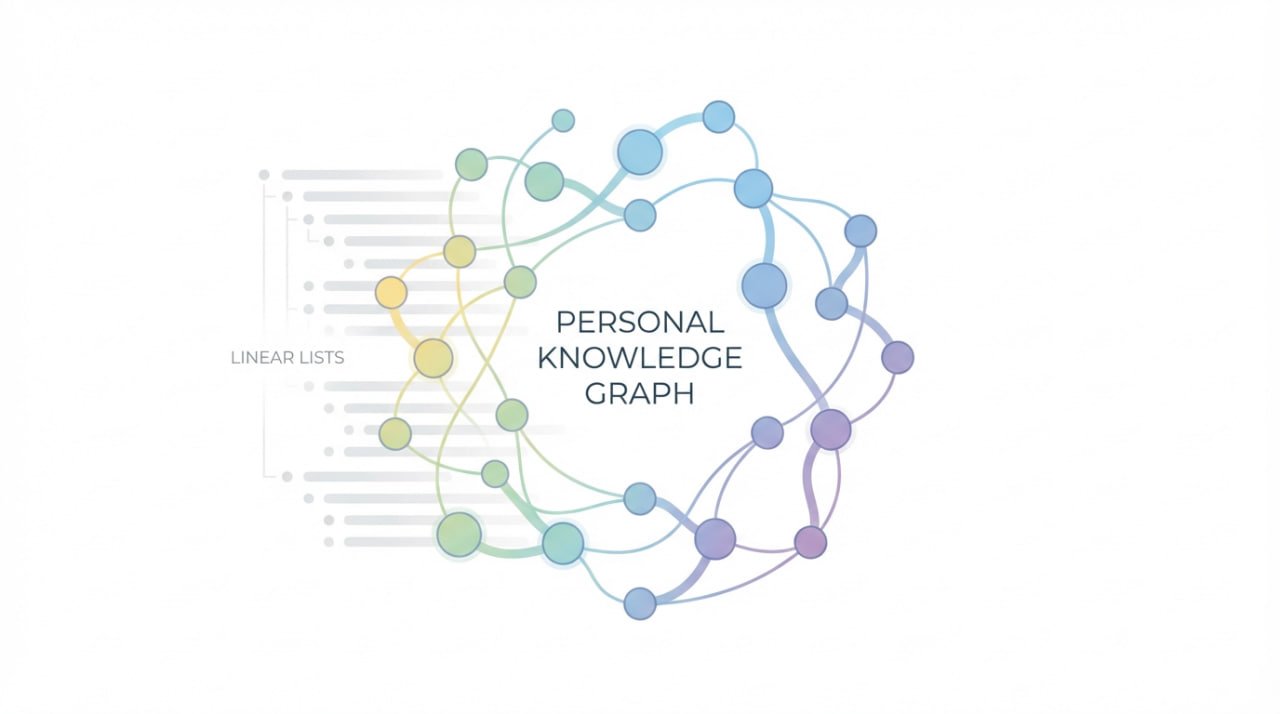
A personal knowledge graph (PKG) is a connected network of your notes, ideas, sources, people, and projects. Instead of storing information in isolated folders, it represents knowledge as nodes and meaningful relationships between them.
To build a personal knowledge graph, choose a tool that supports backlinks or graph visualization, create atomic notes around individual ideas, connect related notes with meaningful links, and review those connections regularly as your knowledge grows.
In this guide, you’ll learn how to build a personal knowledge graph step by step, choose the right tools, create useful connections, and turn scattered notes into a knowledge system you can actually use.
What Is a Personal Knowledge Graph (PKG)?
The phrase “Knowledge Graph” might sound like something that belongs to Google’s engineering team — a complex system powered by algorithms and servers.
But at its core, it’s a profoundly human concept.
A Personal Knowledge Graph (PKG) is a user-centered network of entities — such as ideas, people, sources, projects, and events — and the relationships between them. In academic research, PKGs are generally described as structured knowledge about entities related to an individual, with personal ownership and personalized use being central characteristics.
For personal knowledge management, that concept becomes practical: each useful idea can become a node, while links, backlinks, and relationships show how that idea connects to everything else you know.
If that still feels abstract, imagine this:
“A stack of travel photos shows you where you’ve been.
A world map shows you how those places connect to tell a story.”
That’s exactly what a PKG does for your knowledge — it turns scattered fragments into a connected story. Your PKG is built from just two simple but powerful components:
| Component | Description | Think of it as… |
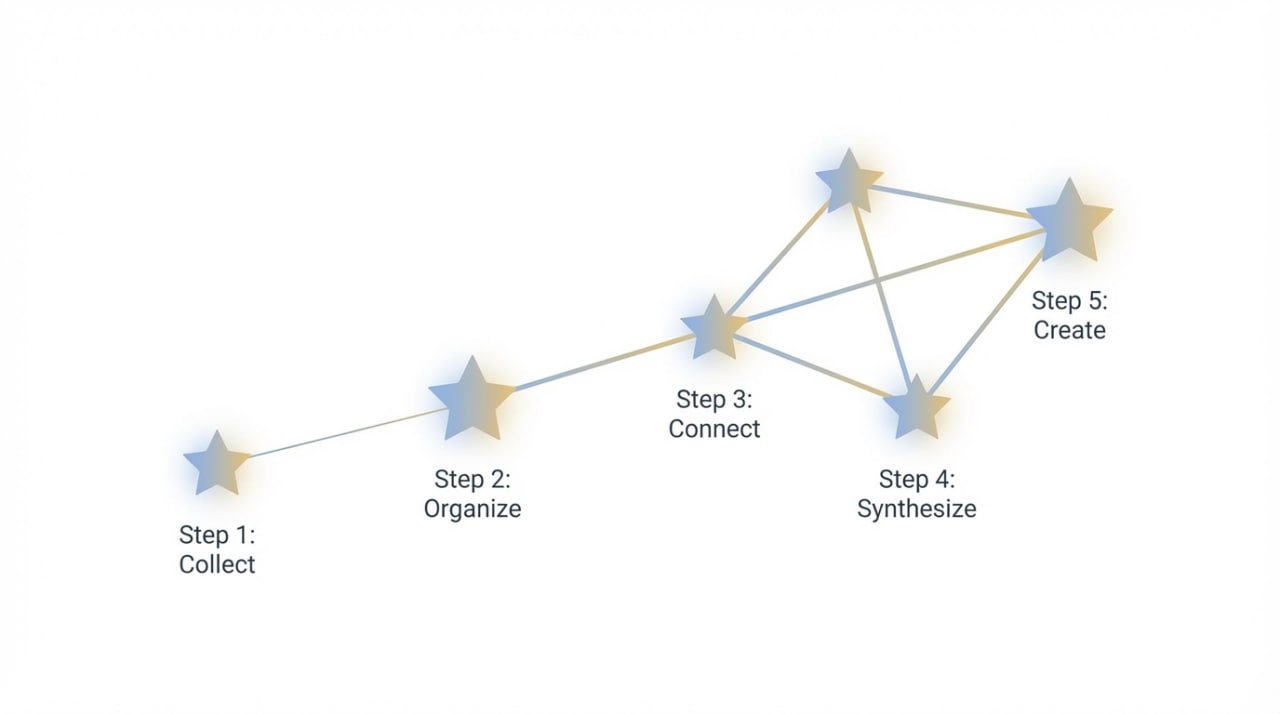
| Nodes (The Stars) | Each node represents a single idea, thought, or note. It’s your basic building block — one concept per note. | A single “star” in your mental constellation. |
| Links (The Lines) | Each link defines how two nodes are related. It’s what transforms isolated stars into constellations. | The “lines” that connect ideas and form patterns. |
Personal Knowledge Graph vs. Personal Knowledge Base
A personal knowledge base primarily helps you capture, organize, and retrieve what you know. A personal knowledge graph puts more emphasis on the relationships between those pieces of knowledge, allowing the same idea to appear in multiple contexts instead of being trapped in a single folder.
A “second brain” is broader still: it describes the overall system or workflow you use to capture and apply knowledge. A personal knowledge graph can be the connected structure inside that second brain.
Nodes Are the Building Blocks of Your Thinking Universe
Each node focuses on one clear idea. That makes it easy to connect without confusion.
Here are examples of what a node could be:
“The strength of your thinking depends on the clarity of your smallest ideas.”
Links Turn Isolated Notes into Connected Insights
This is where the real magic happens. Links are what give your PKG life. They show how your ideas relate to one another — making patterns and connections visible. Instead of just tagging or grouping notes, you link them with intent:
| From | To | Relationship (Link Text) |
| “The Dunning-Kruger Effect” | “Beginner’s Mind” | is a counterpoint to |
| “Tesla’s Alternating Current” | “Thomas Edison” | was a rival of |
| “Q3 Marketing Plan” | “Podcast: Marketing Trends 2024” | uses a strategy from |
The Visual Payoff: Seeing Your Knowledge as a Living Galaxy
Modern PKG tools like Obsidian, Logseq, or Roam Research feature a graph view — a dynamic, zoomable visualization of your notes as dots (nodes) and lines (links).
When you zoom out, you can:
It’s like getting a bird’s-eye view of your own mind. This simple visualization transforms your knowledge from a static library into an interactive landscape you can explore.
Why Build a Personal Knowledge Graph?
Understanding the basics of a Personal Knowledge Graph is one thing — but truly grasping its power? That’s where the magic happens.
This shift can completely transform how you think, create, and see the world. But first, we need to break free from the limitations of the old way of organizing ideas.
From Rigid Folders to Fluid Connections
For years, we’ve been trapped by the folder system — a hierarchy that forces ideas into a one-size-fits-all structure.
A note about “productivity” must live in the “Work” folder, or the “Personal Development” folder. It’s isolated, static, and makes cross-pollination between ideas almost impossible.
This folder system mimics a corporate organization chart — linear, restrictive, and disconnected from the dynamic, interconnected nature of our thinking.
“It prioritizes storage over sense-making.”
In contrast, a Knowledge Graph follows a completely different principle: lateral thinking.
In a graph, your ideas aren’t trapped in folders. They can link freely to other ideas, regardless of their original “category.”
For example, your note on “Newton’s Third Law” can connect to “workplace feedback loops” or “the plot of a novel” — a web of connections that a folder system could never reveal.
The Key Benefits of a Knowledge Graph
This lateral approach unlocks several profound advantages that make a PKG a true game-changer:
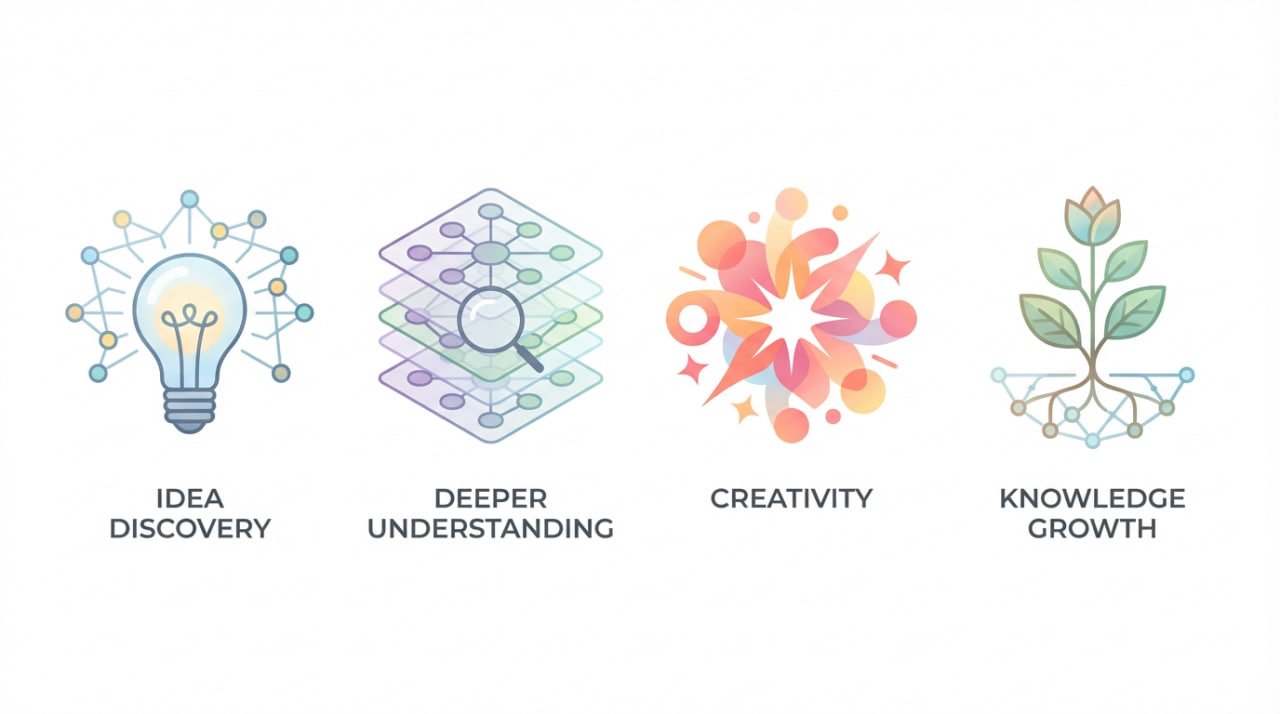
A Knowledge Graph helps you discover unexpected connections, revealing links between ideas you might never have noticed.
Instead of isolating information like traditional folders, it shows the full context around a topic — related notes, evidence, counterarguments, and projects — giving you a deeper, more holistic understanding.
Each new link also strengthens the entire system, making your knowledge base smarter and more insightful over time.
The “Eureka!” Moment: Transforming Skepticism into Belief
This is where the real power shows up. The moment when you realize the graph is more than just a tool — it’s an active thinking partner. You’re struggling to write a blog post introduction, and then — boom! — the perfect structure emerges from related notes.
You’re facing a tough problem at work, and your graph shows you a solution from a completely different field that you’d forgotten about.
“It feels less like searching a database and more like consulting a wiser, more connected version of yourself.”
The real power of a Personal Knowledge Graph is only unlocked through consistent practice. Now that you’ve seen its potential, how do you actually start building your own dynamic web of knowledge?
How to Build Your Personal Knowledge Graph: A Practical, Step-by-Step Guide
The theory is exciting, but the real magic of a Personal Knowledge Graph (PKG) happens when you start building it. And the best part?
You don’t need to be a tech expert to get started. Building your PKG is an iterative, simple process — an experiment in thinking differently, not a daunting project.
Step 1: Choose a Personal Knowledge Graph Tool
The first step is to choose a digital environment designed for connecting ideas, not just storing them. You’ll need a tool built for networked thought — something that enables easy linking of ideas.
Look for features such as backlinks, graph visualization, fast search, portable data formats, and privacy controls. These features matter more than choosing the tool with the longest feature list.
| Tool | Description |
| Obsidian | A powerful, flexible choice with a beautiful Graph View and a strong community. Stores notes as text files on your device, giving you full control. |
| Roam Research | A pioneer in bi-directional linking that shows notes connected to the one you’re currently working on. |
| Logseq | An open-source, outline-based tool that offers powerful connections while feeling familiar. |
Brainfo | An AI-native, local-first workspace with backlinks, a live graph view, semantic search, offline access, and AI that can work across your notes and documents. |
Step 2: Start with Atomic Notes — One Idea Per Note
With your tool set up, the next step is to get started — no perfect plan needed. Just begin capturing your ideas, one at a time.
Step 3: Link with Purpose — Connecting the Dots
This is the most important habit: linking ideas with intention. Linking shouldn’t be a reflex — it should add value.
How to Link Effectively:
Use Descriptive Link Names:
Some tools allow you to add context to your links.
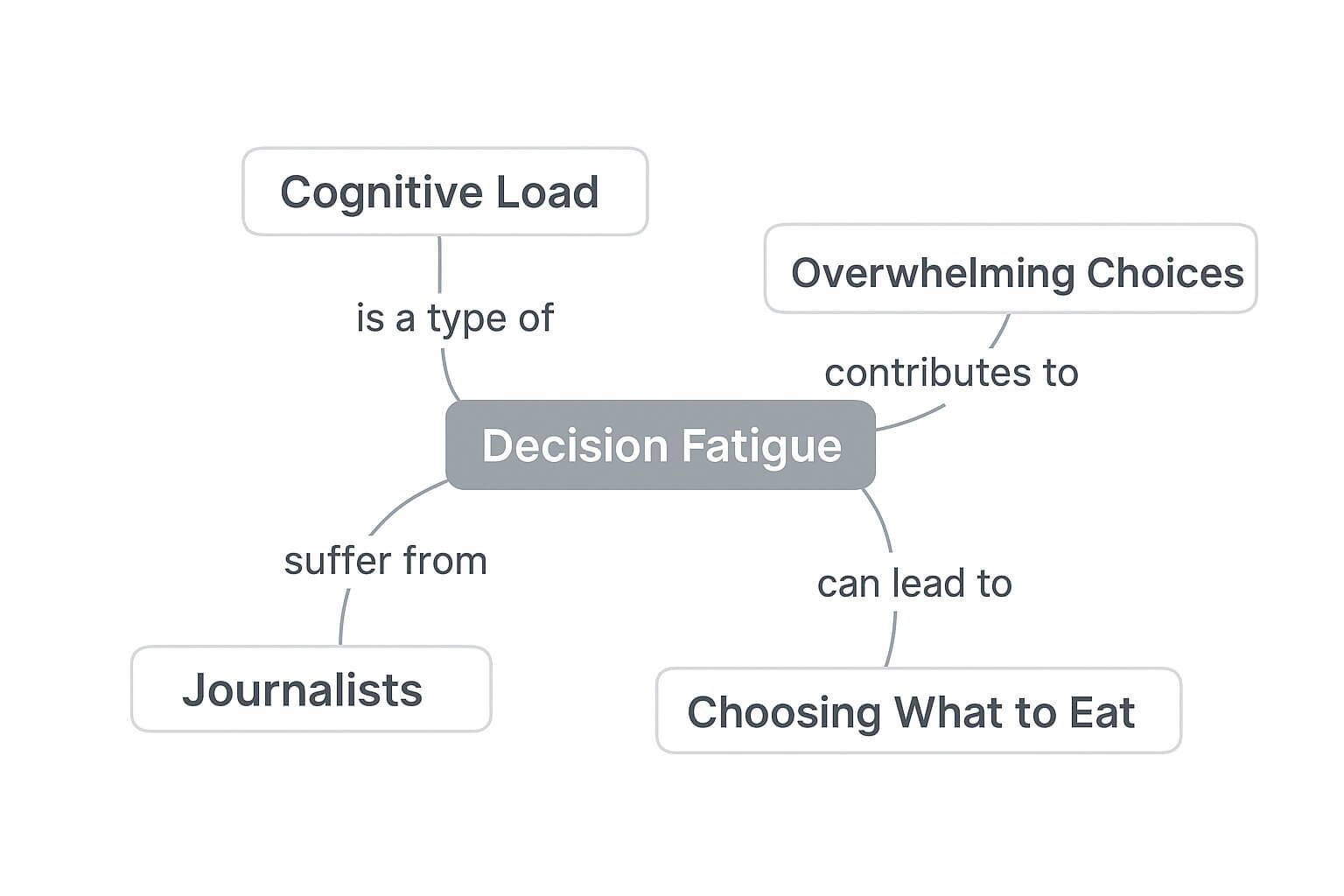
- Instead of linking simply to [[Decision Fatigue]], try “as discussed in [[Decision Fatigue]]” or “this is a prime example of [[Decision Fatigue]]”.
This makes links meaningful and easy to understand later.
A Simple Personal Knowledge Graph Example
Suppose you create a note called “Decision Fatigue.” Instead of leaving it isolated, connect it to:
- Cognitive Load → “is influenced by”
- Deep Work → “can be reduced by”
- Project: Improve My Work Routine → “is relevant to”
Now one idea is connected to a concept, a strategy, and a real project. As you repeat this process, your notes stop behaving like separate documents and start forming a useful knowledge graph.
Step 4: Review and Refine — Fine-Tuning Your Constellations
Your PKG is a dynamic, living system. Regular reviews help turn your notes into a powerful knowledge network.
Explore Your Graph View:
Make it a habit to explore your graph weekly or monthly.
Identify and Strengthen:
The review process helps you:
This process will guide your learning and writing, helping you prioritize where to expand your knowledge.
Building and maintaining your PKG isn’t just about capturing and linking — it’s about developing a mindset of active exploration.
The right tools are useless without the right principles, so make this an ongoing habit that evolves with your thinking.
Best Practices for Maintaining a Personal Knowledge Graph
Building your Personal Knowledge Graph is just like practice, much like meditation or learning a new language.
While the technical steps are straightforward, the real value comes from cultivating the right mindset. Transitioning from a note collector to a curator of connections is key to creating a thriving, dynamic extension of your mind.
Focus on Connection, Not Collection
One of the biggest mistakes beginners make is measuring success by the number of notes. A thousand unconnected notes are just a chaotic collection — not a valuable resource.
Shift your focus: Instead of asking, “How many notes did I add today?” ask, “What meaningful connection did I make today?”
Embrace Imperfection
A messy graph is a thinking graph. In the early stages, your PKG may feel chaotic — and that’s okay.
Let go of control: Resist the urge to create a perfect structure before starting. This is just procrastination.
Build Iteratively
You don’t need a grand plan to start; small, consistent actions are far more effective.
It’s Your Graph
There’s no one “correct” way to build your PKG. You’ll encounter various methods, but remember:
It is you who have the authority: Remember your goal is to create a system that enhances your unique way of thinking.
By adopting these principles, you’ll move from just using a tool to embodying a new way of thinking. Your PKG will become a lifelong practice — nurturing your ideas, cultivating insights, and building a unique landscape of knowledge.
Conclusion: Your Mind, Amplified
We’ve traveled through the power of the Personal Knowledge Graph (PKG) — from the frustration of feeling surrounded by information yet starved for insight, to discovering a revolutionary new way to organize and connect ideas.
By shifting from traditional digital filing systems to a network of nodes and links, we’ve unlocked the potential for dynamic, holistic thinking.
This approach doesn’t just help you store information; it reveals hidden connections, enhances understanding, and compounds your knowledge over time.
We’ve broken down the process:
By focusing on these principles, you’ll create a flourishing, organic network of ideas.
Just as a collection of isolated stars is a night sky, a Personal Knowledge Graph gives you the tools to connect those stars into constellations — and navigate through them.
This is your opportunity to amplify your mind and unlock new levels of insight. The best part? You don’t need to wait. Start small, take that first step, and begin building your constellation of knowledge today.
Get Started Now
Are you ready to turn your notes into a dynamic web of knowledge? Choose a tool, write your first atomic note, and start connecting.
Frequently Asked Questions
1. What is a personal knowledge graph?
A personal knowledge graph is a network of your ideas, notes, people, sources, projects, and other useful information connected through meaningful relationships. Unlike a traditional folder structure, the same idea can connect to multiple contexts.
2. How do you build a personal knowledge graph?
Start by choosing a tool that supports backlinks or graph visualization. Create one focused idea per note, connect related notes with meaningful links, and regularly review your graph to strengthen connections, find knowledge gaps, and remove unnecessary links.
3. What is the difference between a personal knowledge graph and a second brain?
A second brain is the broader system you use to capture, organize, retrieve, and apply knowledge. A personal knowledge graph is one way to structure that knowledge by representing ideas and information as connected nodes and relationships.
4. What is the difference between a personal knowledge graph and a second brain?
A: Stick to tools that use local storage and open formats (like Markdown). This ensures your data remains portable and readable, regardless of the software.
5. Q: How do I revive a neglected or stale graph?
A: Archive the clutter, commit to small daily updates, and start a specific project that forces you to pull insights from your graph to build momentum.
6. Q: How do I decide if a link between notes is worth keeping?
A: Apply the “Sentence Rule”: If you cannot explain the connection between two notes in a single sentence, remove the link to reduce noise.