

Most beginners make Zettelkasten much more complicated than it needs to be.
They start by comparing note-taking apps, designing folder structures, creating complicated tagging systems, and searching for the perfect workflow before they have even written their first useful note.
The result?
A beautifully organized system with almost no valuable knowledge inside it.
A better way to start is much simpler:
Take one useful idea.
Write it clearly in your own words.
Connect it to another idea.
Repeat the process.
That simple habit is the foundation of a Zettelkasten.
The tools can come later. AI can come later too.
When AI becomes part of your workflow, its role should be helping you remove repetitive work around thinking, not replacing the thinking process itself.
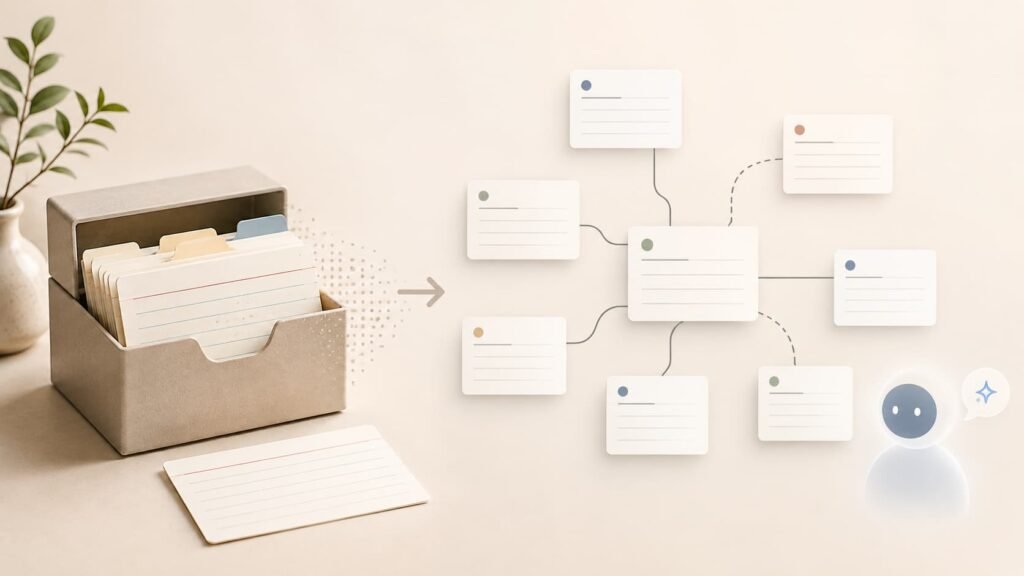
Quick Start: Build Your First Zettelkasten in 10 Minutes
If you are completely new to Zettelkasten, start with this simple workflow:
- Choose one place for your notes
It can be a paper notebook, a simple notes app, or a dedicated knowledge management tool.
- Capture one useful idea
Do not try to save everything you read. Keep ideas that may help you think, write, or solve problems later.
- Rewrite the idea in your own words
A note becomes valuable when you understand it, not when you copy it.
- Give the note a clear title
Your future self should understand the idea without reopening the original source.
- Connect it to another note
Explain why these two ideas belong together.
- Return to your notes during real work
Use your knowledge system when writing, researching, planning, or making decisions.
A Zettelkasten becomes useful through repeated use, not through perfect setup.
What Is the Zettelkasten Method?
Zettelkasten is a method for building a collection of connected notes.
The German word Zettelkasten means “slip box” or “card index.” The method is strongly associated with German sociologist Niklas Luhmann, who used a large collection of physical notes connected through references.
The important part of the method is not the physical box.
The important part is the relationship between ideas.
A traditional notebook usually stores information by pages:
A Zettelkasten works differently.
Instead of thinking in pages, you think in ideas.
A note about memory can connect to a note about sleep.
That note can connect to spaced repetition.
Another note may challenge or expand those ideas.
Over time, your collection becomes a network of knowledge that helps you write, research, plan, and solve problems.
Zettelkasten Explained Simply
Think of a Zettelkasten as a collection of small, focused notes that can communicate with each other.
Each useful note should make sense when you return to it weeks or months later.
Instead of creating one large note called:
“Book Notes”
and putting dozens of unrelated ideas inside it, you separate important concepts into individual notes and connect them when a relationship exists.
The goal is not to store everything you consume.
The goal is to preserve ideas that you understand well enough to use again.
Why Connected Notes Matter More Than Storage
Many people approach note-taking as a storage problem.
They ask:
But a Zettelkasten asks a different question:
How does this idea connect to what I already know?
The value of the system comes from discovering relationships between ideas.
A note by itself is only information.
A connected note becomes part of your thinking system.
How Does a Zettelkasten Actually Work?
A practical Zettelkasten follows a simple loop:
Capture → Understand → Rewrite → Connect → Retrieve
The process looks like this:
- Encounter an idea.
- Decide whether it is worth keeping.
- Rewrite it so you understand it.
- Store it as a focused note.
- Connect it to related ideas.
- Use those connections during real work.
Capturing information is easy.
Creating meaningful connections requires judgment.
Why Atomic Notes Matter
A useful Zettelkasten note usually focuses on one idea.
These are often called atomic notes.
An atomic note should be understandable on its own and flexible enough to connect with other ideas.
For example:
A weak note:
Sleep research
Sleep affects memory, mood, creativity, attention, learning, stress, and health.
This contains many concepts but no clear idea.
A stronger note:
Sleep can support memory consolidation This note has a specific claim and can connect naturally to other ideas about learning and memory.
Explain Why Two Notes Connect
Simply linking two notes is not enough.
A connection becomes valuable when you explain the reason behind it.
For example:
Note 1: Sleep can support memory consolidation.
Note 2: Spaced practice improves long-term retention.
A weak connection:
Related: Sleep and spaced practice.
A stronger connection:
Both ideas show that learning continues after the first exposure to information. What happens after studying can influence what remains accessible later.
The explanation records your thinking, not just the existence of a relationship.
Let Structure Emerge From Use
One of the biggest mistakes beginners make is creating structure before they have enough notes.
They build folders for:
Then they spend more time deciding where a note belongs than developing the note itself.
A Zettelkasten does not require you to design your entire knowledge architecture on the first day.
Start with:
As patterns appear naturally, you can create higher-level structures around those patterns. The system should grow from your thinking, not force your thinking into a predefined structure.
The Three Types of Zettelkasten Notes
Modern Zettelkasten guides often describe three common types of notes:
- Fleeting notes
- Literature notes
- Permanent notes
These categories are useful for understanding the workflow, but they should not become a complicated rule system.
The most important thing is understanding how an idea moves from a temporary capture into a valuable piece of knowledge.
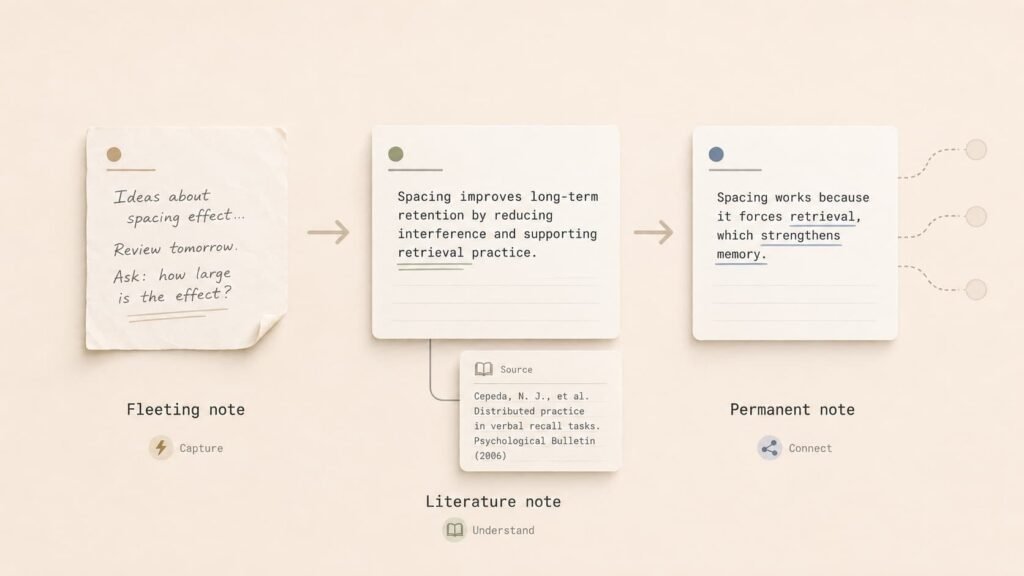
Fleeting Notes: Capturing Ideas Before They Disappear
A fleeting note is a quick capture of an idea before you forget it.
It does not need to be perfect.
Example:
Maybe sleep matters more after difficult learning?
This is not a finished knowledge note.
It is simply a reminder that something may be worth exploring later.
After reviewing it, you can:
Literature Notes: Understanding External Sources
A literature note records useful information from a source.
The source could be:
A practical literature note may include:
Source: Research paper about sleep and memory
Main idea: Sleep contributes to some forms of memory processing after learning.
My interpretation: This may connect with retrieval practice because both focus on what happens after initial exposure to information.
The important distinction is keeping the author’s ideas separate from your own interpretation.
A source provides information.
Your note should show what that information means to you.
Permanent Notes: Ideas Worth Keeping
A permanent note contains an idea that you expect to remain useful.
It should make sense even if you read it months later without opening the original source.
For example:
Learning continues after the study session ends
A study session creates an initial memory, but later processes influence whether that memory remains useful. Sleep-related consolidation is one example of how learning continues after the original moment of studying.
This note can connect to:
It is no longer just a summary of a single source.
It has become part of your own knowledge system.
A Real Zettelkasten Example: From One Idea to Connected Knowledge
Imagine you are researching learning and memory.
You find information about sleep-dependent memory consolidation.
Instead of simply saving the article, you create a literature note:
Sleep and memory
Sleep after learning can support memory consolidation. The exact effect depends on the type of memory and the stage of processing.
Source: Sleep-Dependent Memory Consolidation and Reconsolidation
Now ask a more important question:
What is the idea here that matters to my work?
You create a permanent note:
Learning does not stop when practice stops
A study session creates an initial memory, but later processes influence whether that memory remains useful. When designing a learning routine, the time after studying also deserves attention.
Now you search your existing notes and discover another idea:
Spaced repetition separates encoding and retrieval
You connect them:
Both ideas challenge the assumption that learning quality depends only on what happens during the first study session.
A few days later, another idea appears:
Good learning systems manage time between study sessions
This new note connects to both previous ideas.
The important point:
You did not create a folder called:
“Everything about the role of time in learning”
before starting.
The theme appeared because different ideas naturally connected around the same problem.
That is exactly what a Zettelkasten is designed to do.
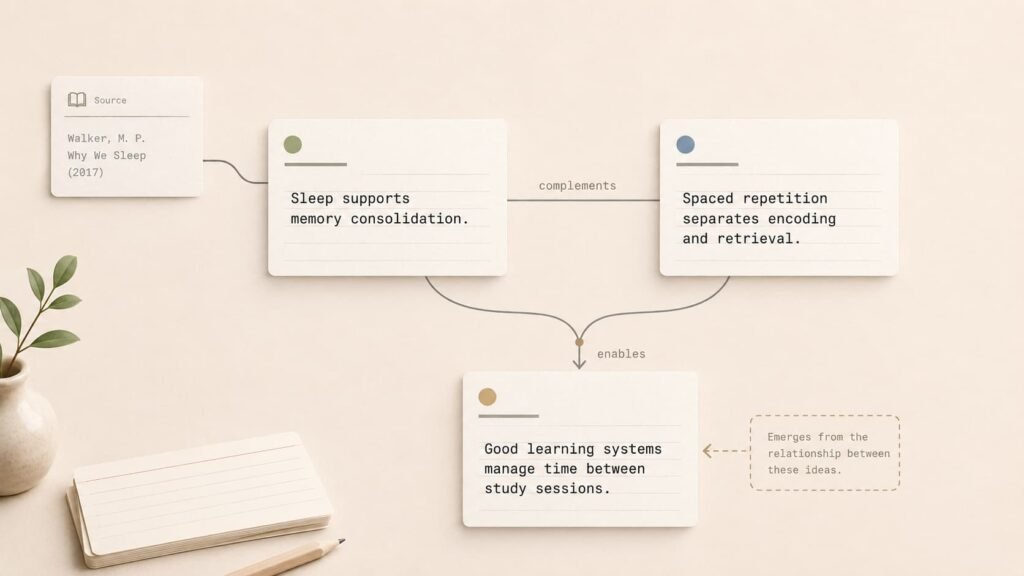
How to Start a Zettelkasten Step by Step
You do not need a large migration project or a complicated setup.
You need one source, one useful idea, and a repeatable process.
Step 1: Choose One Place for Your Notes
A Zettelkasten can work with different tools:
- Paper cards
- Simple note applications
- Digital knowledge management platforms
Choose a system where you can:
- Write comfortably
- Find notes later
- Create connections between ideas
Your first tool will teach you more about your actual needs than hours of comparing different apps.
Step 2: Capture Ideas Worth Keeping
Do not save every sentence that sounds interesting.
Keep ideas that:
- Change your perspective
- Explain something clearly
- Connect to an existing problem
- Challenge something you already believe
- May become useful in future work
A smaller collection of ideas you understand is more valuable than a huge archive you never revisit.
Step 3: Rewrite Important Ideas in Your Own Words
Copying information is not the same as understanding it.
A useful test:
Close the original source.
Can you explain the idea yourself?
If not, return to the source and try again.
The process of rewriting is where information starts becoming part of your own thinking.
Step 4: Make Each Permanent Note Understandable on Its Own
A permanent note should not depend on your memory of the original source.
A title like:
Thoughts from chapter 4
does not tell your future self anything useful.
A stronger title:
Reducing friction makes habits easier to repeat
immediately communicates the idea.
When writing permanent notes:
- Give the note a clear title.
- Explain the main idea.
- Add enough context for future understanding.
- Keep the original source available when needed.
A good note should still make sense months later, even if you no longer remember the article, book, or conversation that created it.
Step 5: Connect Each New Note Where It Matters
Before finishing a permanent note, look for relationships.
Ask:
- Does this connect to an existing idea?
- Does it support another note?
- Does it challenge something I already know?
- Does it provide an example?
- Does it explain a consequence?
Then record the relationship.
For example:
This idea connects with habit formation because both focus on reducing the effort required to repeat a behavior.
The connection itself becomes valuable knowledge.
If a new note has no obvious connection yet, that is completely fine.
Not every idea needs immediate classification.
The system is allowed to have unfinished connections.
Step 6: Retrieve Notes During Real Work
A Zettelkasten becomes powerful when you use it.
Open your notes when you:
- Write an article
- Prepare a presentation
- Research a topic
- Solve a problem
- Build an argument
- Plan a project
Start with one relevant note and follow the connections.
Over time, groups of related notes will naturally appear.
When several notes repeatedly connect around one theme, you may create a structure note or overview.
Create structure because the knowledge exists.
Do not create it because a template told you to.
Do You Need Numbers, IDs, and Index Cards?
Niklas Luhmann’s original Zettelkasten used numbers because it was a physical card system.
Each card needed a stable location so it could be found again.
Digital systems change this requirement.
Today, notes can use:
You can still use traditional numbering systems if they help you.
But the number itself is not what creates knowledge.
The important parts are:
Do not spend your first day creating a perfect ID system.
Spend it creating useful notes.
Analog vs Digital Zettelkasten
Both physical and digital Zettelkasten systems can work.
The better choice depends on how you think and work.
| Analog Zettelkasten | Digital Zettelkasten |
| Physical index cards | Digital notes |
| Manual references | Links and backlinks |
| Physical browsing | Search and navigation |
| Handwritten connections | Clickable relationships |
| Limited physical space | Easy expansion |
| No software configuration | Faster editing and retrieval |
Paper systems have advantages:
Digital systems have different advantages:
Neither format automatically creates better thinking.
A digital vault full of copied text is still just storage.
A small collection of carefully written notes can become a powerful thinking system.
Choose the system you will actually use.
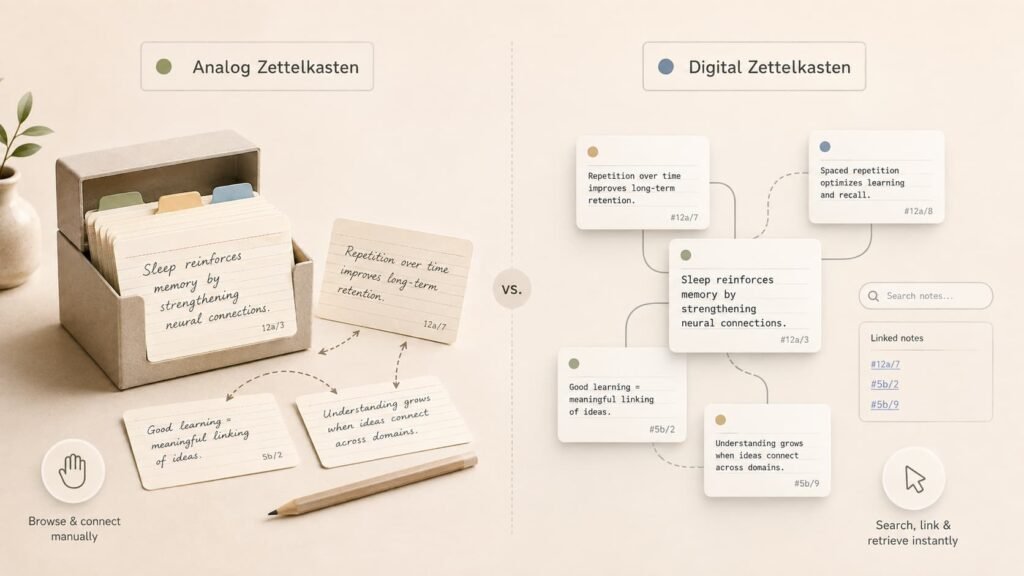
How AI Changes the Zettelkasten Workflow
AI can make parts of knowledge work faster.
It can help with:
However, the core value of Zettelkasten comes from human understanding.
AI should reduce friction around thinking, not replace thinking.
Where AI Helps in a Zettelkasten
Imagine you have a 100-page research report.
AI can help you:
But the final note should come from your understanding.
AI output is a starting point.
It is not automatically a permanent note.
Where AI Should Not Replace You
A tempting workflow looks like this:
- Upload a book to AI.
- Ask for 50 atomic notes.
- Automatically create connections.
- Import everything.
- Repeat.
The result may look impressive.
You may have:
- Hundreds of notes
- Many links
- A large knowledge archive
But when you need to write or think, you may discover that you never truly understood the material.
The problem is not the amount of information.
The problem is the missing thinking process.
A better rule:
Use AI to organize and explore. Keep the understanding and decisions human.
A Simple AI-Assisted Zettelkasten Workflow
The process can remain simple:
Source → Capture → Understand → Rewrite → Link → Retrieve
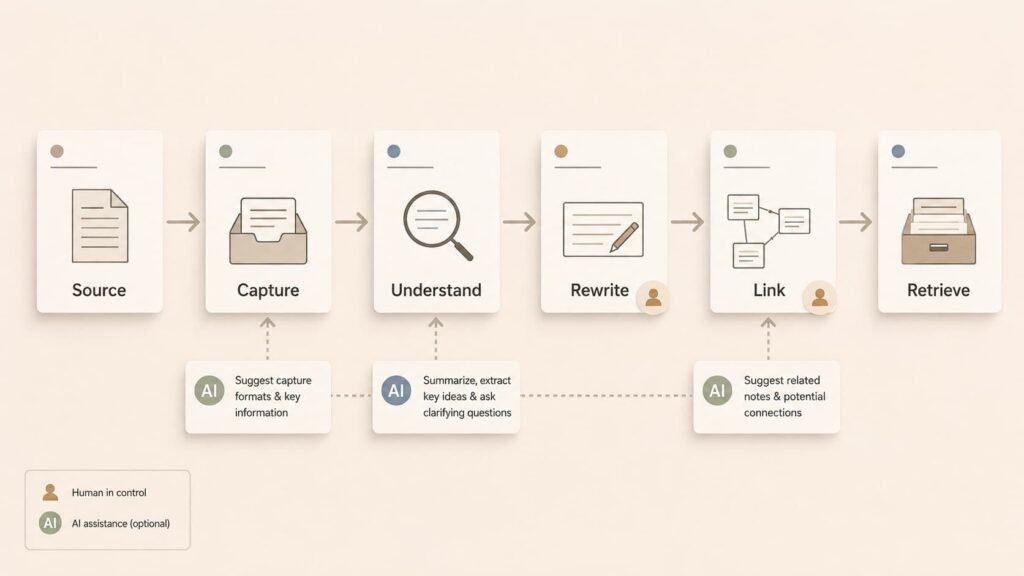
1. Start With a Source
Your source can be:
- A book
- Research paper
- Article
- Meeting notes
- Transcript
- Personal observation
2. Capture Candidate Ideas
Write quick notes.
AI can help identify potentially useful sections.
But do not save everything.
Choose ideas worth thinking about.
3. Understand the Idea
Return to the original source.
Check:
- Context
- Evidence
- Meaning
- Limitations
If AI created the summary, verify it.
4. Rewrite It
Explain the idea in your own words.
This is the point where information becomes knowledge.
5. Connect It
Search your existing notes.
Find relationships.
Explain why the connection exists.
AI can suggest possibilities.
Your judgment decides what belongs in your knowledge system.
6. Retrieve It
Use your notes when doing real work.
A note that never helps you think is only stored information.
A note that repeatedly helps you solve problems becomes part of your second brain.
Using Brainfo for an AI-Assisted Zettelkasten
You do not need a specific application to use the Zettelkasten method.
The method depends on how you capture, understand, rewrite, and connect ideas.
However, using a digital workspace can make parts of the process easier, especially when your workflow includes:
- Research
- Document analysis
- Writing
- Organization
- Finding previous ideas
Brainfo is one example of a digital workspace designed around this type of knowledge workflow.
Instead of treating notes as isolated files, a system like Brainfo can help bring together different parts of knowledge work in one environment.
A practical AI-assisted workflow could look like this:
Step 1: Research and Collect Information
Start with a source:
- Upload a document
- Research a topic
- Collect useful references
- Review existing material
AI can help you make an initial pass through information and identify areas that deserve attention.
Step 2: Create Initial Notes
After reviewing the material, create rough notes.
At this stage, the goal is not to create perfect permanent notes.
Capture:
- Important concepts
- Questions
- Possible connections
- Ideas worth exploring
Step 3: Verify and Understand
Before turning a note into permanent knowledge, return to the original source.
Ask:
- Is this idea accurate?
- Did I understand the context?
- Does this information actually matter?
AI can accelerate exploration, but understanding remains your responsibility.
Step 4: Rewrite Permanent Notes
Transform information into your own thinking.
A permanent note should:
- Have a clear title
- Explain one idea
- Include enough context
- Make sense without reopening the source
Step 5: Connect Ideas
Search your existing notes.
Find:
- Similar concepts
- Opposing ideas
- Examples
- Consequences
- Related problems
Then explain why the relationship matters.
Connections are where a collection of notes becomes a knowledge system.
Common Zettelkasten Mistakes Beginners Make
Most beginner problems come from adding complexity too early.
A useful Zettelkasten does not require hundreds of rules.
It requires consistent thinking.
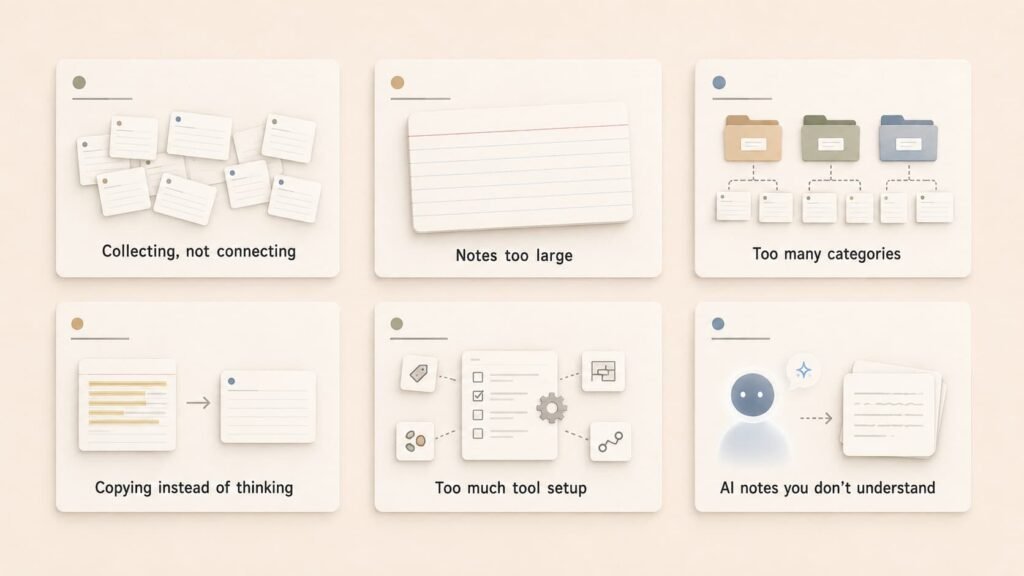
Mistake 1: Collecting Instead of Connecting
Saving information is easy.
Understanding relationships between ideas is harder.
Many people build large collections of highlights and summaries but rarely explain:
- Why does this matter?
- How does this connect to something else?
- When could I use this idea?
Spend more time connecting than collecting.
Mistake 2: Creating Notes That Are Too Large
A note containing hundreds or thousands of words about a broad topic becomes difficult to reuse.
For example:
Marketing
is too broad.
A better approach:
- Customer trust influences buying decisions
- Clear positioning reduces decision friction
- Social proof changes perceived value
Each note becomes easier to connect and reuse.
Mistake 3: Creating Categories Too Early
Many beginners try to design the perfect structure before they have enough information.
They create:
- Complex folders
- Large tag systems
- Multiple categories
But the best structure usually appears after using the system.
Let repeated ideas show you what structure you need.
Mistake 4: Copying Instead of Thinking
A saved quote is not automatically knowledge.
A quote preserves someone else’s words.
A permanent note should show:
- What you understood
- Why it matters
- How it connects to your existing ideas
Mistake 5: Spending More Time Configuring Tools Than Using Them
Templates, plugins, themes, and workflows can become distractions.
A simple system that you use consistently is better than a perfect system that prevents you from creating notes.
The goal is not to build the most impressive setup.
The goal is to build a system that improves your thinking.
Mistake 6: Letting AI Create Notes You Do Not Understand
AI makes it easier to generate large amounts of information.
But quantity is not the same as knowledge.
Before keeping an AI-generated note, ask:
Do I understand this idea well enough to explain it?
If the answer is no, it is not ready to become part of your permanent knowledge system.
What Should Your Zettelkasten Look Like After 30 Days?
Probably smaller than you expect.
And that is a good sign.
After one month, you do not need thousands of notes.
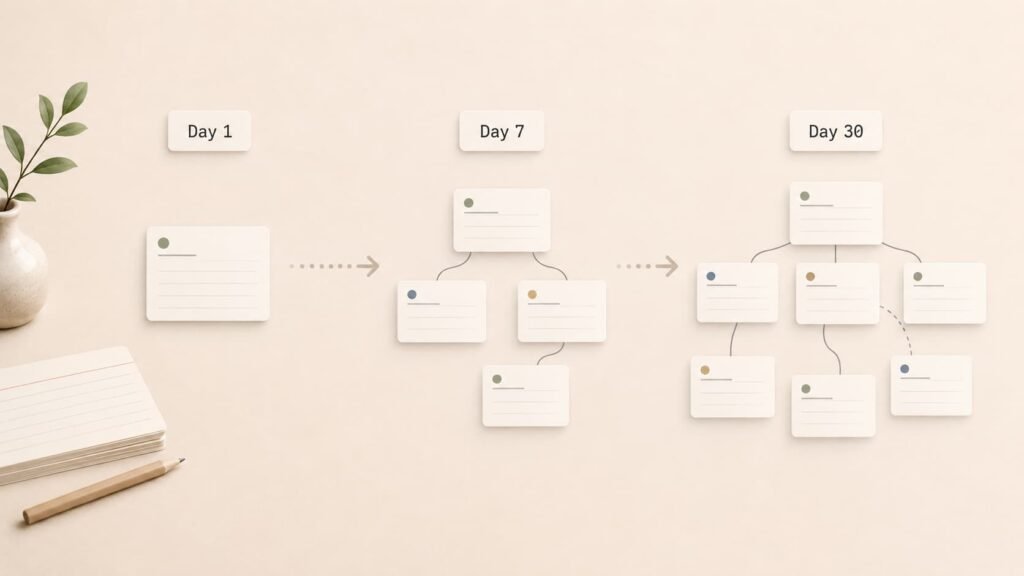
A useful early Zettelkasten may contain:
Some notes will become important.
Some will remain isolated.
Some will eventually be deleted.
That is part of the process.
Your system improves as you learn how you think.
Measure Progress by Retrieval, Not Note Count
The number of notes you create is not the main measurement.
A better question:
Did an old note help me solve a new problem?
When a previous idea suddenly becomes useful in a new situation, your Zettelkasten is doing its job.
Zettelkasten FAQ
What is the Zettelkasten method in simple terms?
The Zettelkasten method is a way to create focused notes and connect related ideas.
Instead of only organizing information by folders or topics, you build relationships between ideas so your knowledge becomes easier to explore and reuse.
How do I start a Zettelkasten as a beginner?
Start with one place for your notes.
Then:
Capture a useful idea.
Rewrite it in your own words.
Give it a clear title.
Connect it to another idea.
Use it during real work.
Do not worry about advanced systems before building the habit.
How many notes should I create every day?
There is no universal number.
One meaningful, well-connected note can be more valuable than many notes created only to increase your count.
Focus on quality and usefulness.
Is digital Zettelkasten better than paper?
Neither option is automatically better.
Paper offers simplicity and focus.
Digital systems provide:
Faster search
Easier editing
More connections
Better integration with modern workflows
Choose the format that matches how you naturally work.
Can AI be used with Zettelkasten?
Yes.
AI can help with:
Summarizing information
Reviewing documents
Cleaning rough notes
Finding useful material
But permanent notes should reflect your own understanding and judgment.
Start Small and Let Your Knowledge System Grow
You do not need the perfect application.
You do not need hundreds of categories.
You do not need a complicated workflow.
Start with one idea.
Write it clearly.
Connect it to another idea.
Use it when you think, write, or solve problems.
A Zettelkasten grows through consistent practice.
The foundation remains simple:
Understand the idea.
Write it down.
Connect it.